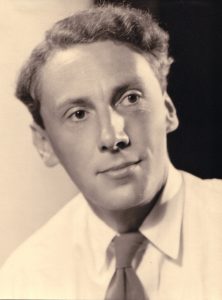
Max Lock was one of the twentieth century’s most influential, yet often overlooked, town planners. At a time when planning largely focused on rebuilding towns and cities and reshaping their physical environments, Lock believed that successful planning should begin with an understanding of people and their communities.
His guiding principle was that planning should be carried out “with the inhabitants rather than for them.” Through social research, public consultation and collaboration across different disciplines, he helped develop approaches to planning that remain relevant today.
The importance of his work is reflected in the Max Lock Archive, deposited in the University Archive in 1999 by the Max Lock Centre. Established in 1994, the Centre was created to promote research into the social and people-centred planning principles that shaped his career.
Lock trained as an architect at the Architectural Association, combining modernist ideas with a strong sense of social responsibility, influenced by his Quaker beliefs.
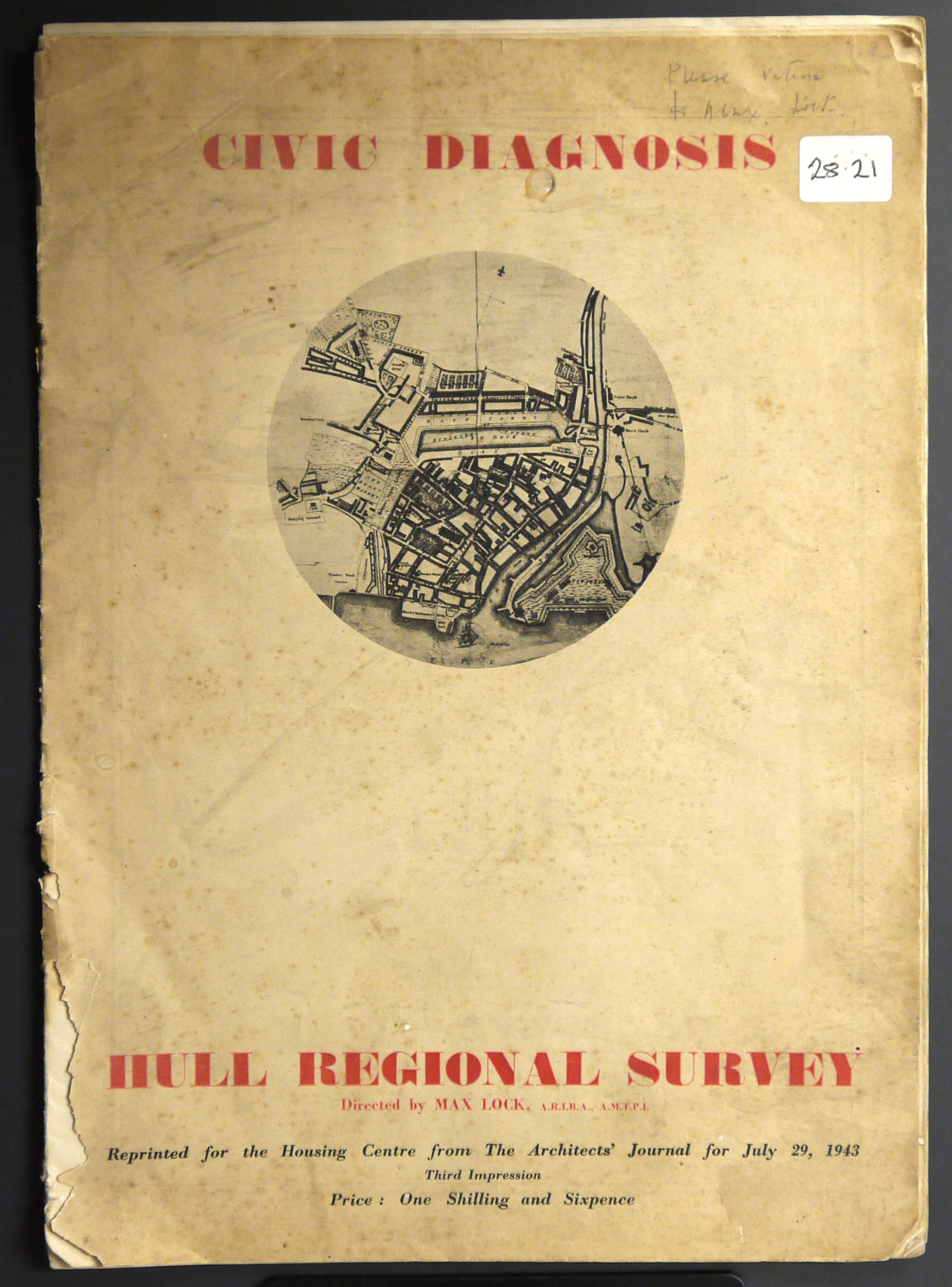
During the Second World War, he led the Hull Regional Survey: Civic Diagnosis (1943). This pioneering study examined the town’s social, economic and environmental conditions to identify issues and inform future planning.
Influenced by planner Patrick Geddes and his principle of “survey before plan”, Lock believed that planners needed to understand a place before deciding how to change it. As he famously argued: “The planner should diagnose before he prescribes.”
For Lock, planning was about much more than buildings, roads and land use. It needed to be grounded in an understanding of how people lived, worked and interacted within their communities.
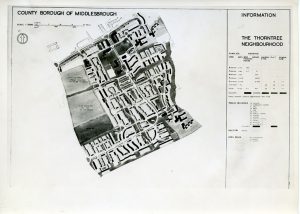
One of Lock’s most significant projects was the Survey and Plan for the County Borough of Middlesbrough (1944–46). Commissioned to guide the town’s post-war reconstruction, it became one of the most influential planning studies undertaken in Britain.
Lock brought together architects, planners, geographers and sociologists, including A. E. Smailes and Ruth Glass. Together, they investigated a wide range of issues, including housing, transport, health, education, employment, recreation and neighbourhood life.More than 2,500 residents contributed to the research, making it one of the largest public opinion surveys undertaken for a British planning project at the time.
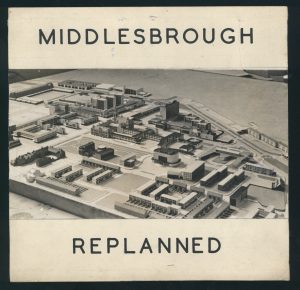
Lock regarded local people as the planners’ most important clients. To ensure their views helped shape the proposals, his team took an unusually open and inclusive approach. They opened a public consultation office in the town centre; organised exhibitions and public meetings; produced accessible pamphlets and models to explain the proposals; and gathered residents’ views through surveys and discussions. Around 22,000 people visited the public exhibition, leading many to describe the scheme as a “people’s plan”.
In January 1946, Middlesbrough Corporation approved the plan in principle as a guide to the town’s future development. Its proposals included housing renewal, improved public services, better neighbourhoods and healthier living environments. Contemporary commentators described it as one of the most comprehensive town-planning schemes ever prepared in Britain.
What distinguished Lock’s approach was his belief that all aspects of community life were interconnected. Housing, health, education and recreation should not be considered separately, but as parts of a wider social system. Lock saw planning as a means of improving quality of life, rather than simply rebuilding urban areas. Involving residents was therefore central to the process, giving them a genuine opportunity to influence decisions about the places where they lived.
His approach helped shape post-war planning in Britain and reflected principles later embedded in the Town and Country Planning Act 1947. Many ideas now considered fundamental to planning practice, including evidence-based decision-making, interdisciplinary collaboration and community engagement, were already central to Lock’s work decades earlier. He continued to develop these principles in later projects, including the Bedford Plan, where he sought to accommodate new development while respecting the town’s historic character.
From the 1950s onwards, Lock established himself as an influential international planner. Through lectures, advisory missions and consultancy work, he shared his planning philosophy with countries around the world, including India, Iraq and Nigeria, among others.
His work promoted several key principles: understanding local conditions before making plans, involving communities in decision-making, integrating social and physical development, and strengthening planning institutions and education.
Despite his considerable influence, Lock never achieved the same public recognition as some of his contemporaries. Much of his later career was spent overseas, and he did not produce a single defining publication that secured his place in mainstream planning history.
As the planning profession became increasingly specialised and technical, his emphasis on social research and community participation was often overlooked. However, more recent research has brought renewed attention to his contribution. Historians increasingly recognise Lock as a pioneer of participatory planning, social research and interdisciplinary practice.
His work demonstrated that successful planning is about much more than designing buildings, roads and public spaces. It requires an understanding of the people who live in a place, listening to their views and responding to their needs and aspirations. His belief that planning should be undertaken “with people, not just for them” remains as relevant today as it was during his lifetime.
University of Westminster
309 Regent Street, London W1B 2UW
General enquiries: +44 (0)20 7911 5000
Course enquiries: +44 (0)20 7915 5511
The University of Westminster is a charity and a company limited by guarantee. Registration number: 977818 England