
Written by Diya Shah, Entrepreneurship, Innovation and Enterprise Development MSc student
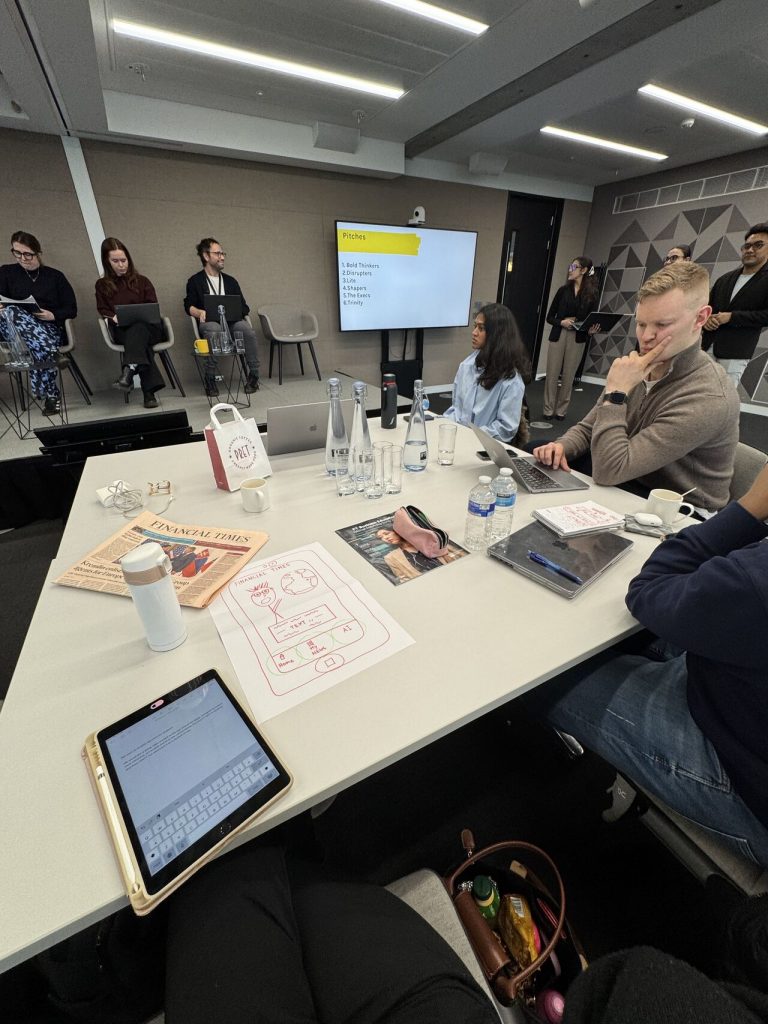
As part of our module in Entrepreneurship, Innovation and Enterprise Development MSc, we were given the opportunity to participate in a live hackathon hosted at the headquarters of the Financial Times in London. This was not a simulation. It was an immersive, real-world innovation sprint inside one of the most respected global media organisations.
Walking into the FT building, I immediately felt the weight of expectation. This was an organisation built on credibility, precision and strategic thinking. The standard was clear from the beginning: ideas needed to be original, but also realistic, valuable and aligned with the FT’s premium positioning. Being part of this experience was both intimidating and energising. I found myself thinking not just like a student, but like a Financial Times employee under pressure.
Challenge One: Reimagining the FT App Through Exaptation
Our first challenge was to develop an exaptation solution for the FT app. Which is taking an existing feature or capability and adapting it for a new purpose; not inventing something entirely new but unlocking new value from what already exists.
Before we began brainstorming, the FT team set clear expectations. Our ideas had to:
-
- Does this idea genuinely add value?
-
- Is it socially engaging and interactive?
-
- Does it align with the FT’s premium brand and long-term strategy?
With only 45 minutes to work, the pressure was immediate. My team, Tania, Arbin and myself, quickly realised that creativity alone would not be enough. We needed strategic logic behind every suggestion.
We explored how existing AI-driven personalisation tools, data visualisation formats, and content categorisation systems could be adapted to create a more interactive and educational user experience. The challenge was to enhance accessibility without diluting the authority and credibility that define the FT.
Delivering a one-minute elevator pitch was one of the most intense parts of the experience. There was no space for unnecessary detail. We had to communicate clarity, commercial sense and strategic fit within seconds. The feedback from the FT professionals was direct and analytical. They questioned scalability, sustainability, technical feasibility and long-term brand impact. It felt less like a classroom presentation and more like presenting to senior stakeholders.
Challenge Two: Reimagining the “Ask FT” Feature
The second round raised the stakes even further. We had only 30 minutes to create an exaptation solution for the Ask FT feature within the FT app.
This time, the focus went beyond creativity. We were asked to evaluate our ideas through a more mature, business-led lens:
-
- Is this solution sustainable?
-
- Can it support social interaction, and meaningful engagement?
-
- Does it realistically fit within the FT’s digital ecosystem?
What impressed me most was how quickly all the teams, including mine, adapted based on earlier feedback. The ideas became sharper, more grounded, and more aligned with the FT’s identity. Many teams explored how Ask FT could evolve into a more community-driven and educational tool, without compromising the publication’s credibility or trust.
Despite the shorter time frame, the depth of thinking in the room was remarkable. The FT team’s genuine engagement with our ideas made the experience incredibly motivating. It felt like our perspectives mattered.
Learning Beyond the Classroom
For me, this hackathon blurred the line between academia and industry. It tested how well I could collaborate under pressure, communicate ideas succinctly, and think strategically in real time.
What students should know is this: hackathons like these are not about having the “best” idea. They are about learning how to evaluate ideas quickly, refine them intelligently, and pitch them confidently. For business leaders, the takeaway is equally important, innovation thrives when young minds are given real problems, real constraints, and real responsibility.
The day concluded with a rooftop tour overlooking London, a moment that allowed me to pause and reflect. Standing there, I realised how rare and valuable it is to experience innovation from inside an organisation that sets global standards for journalism and business thinking. This visit showed me that innovation is not just about generating ideas but it’s about pressure, precision, and purpose. And that is a lesson I will carry far beyond the classroom.

Interested in studying Entrepreneurship, Innovation and Enterprise Development MSc at Westminster? Visit our course page to learn more about the degree, modules, industry opportunities, and what our students experience throughout their studies.
