

Building Real-World Skills Inside Westminster’s Fabrication Laboratory
- August 20, 2025
- Student experience Undergraduate
- No Comments
At the University of Westminster, our Construction Management BSc students don’t just learn about construction—they actively participate in it. From managing budgets and schedules to navigating complex stakeholder communications, construction management is a discipline that requires both strategic thinking and practical know-how. That’s why our course goes far beyond traditional classroom learning, offering hands-on, industry-informed experiences from day one.
Our undergraduate Construction Management degree is seeking reaccreditation by the Chartered Association of Building Engineers (CABE) and Chartered Institute of Building (CIOB). Our courses are professionally orientated, producing graduates capable of dealing with the technological and managerial processes associated with the production and post-construction life of buildings. From the outset, students are immersed in professional practice through close partnerships with leading organisations such as Great Portland Estates, Mace, and The Crown Estate. These collaborations give students access to real-time insights into industry developments and opportunities to learn directly from professionals at the forefront of the construction sector. Site visits to major projects—including Zone29, the University’s new hub for student enterprise and career development set to open in early 2026—further deepen this real-world engagement.
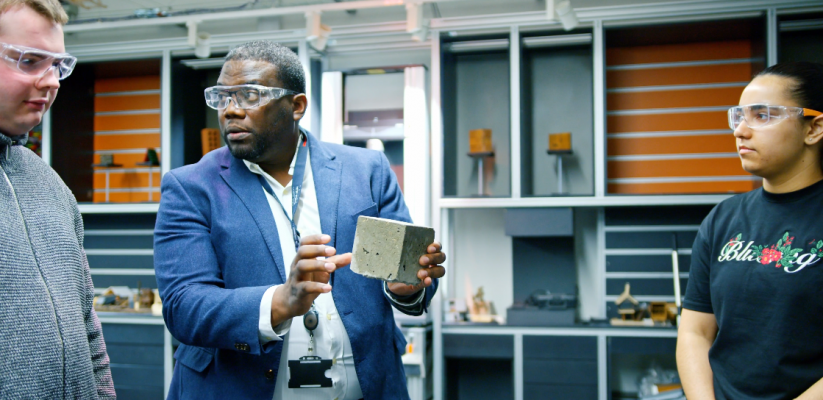
A standout feature of the course is access to the University’s cutting-edge Fabrication Laboratory, where students have the opportunity to turn classroom theory into tangible results. Unlike many undergraduate construction management programmes, Westminster places a strong emphasis on hands-on, experiential learning.
In the Fabrication Lab, students use the latest equipment and technology to simulate real-world construction environments. This immersive approach helps them understand how abstract concepts apply in practice—whether through material testing, model construction, or advanced digital fabrication techniques.
The state-of-the-art laboratories are equipped with the latest technology and equipment, providing a practical, hands-on learning environment that is invaluable for understanding complex concepts. These labs are not just advanced but also simulate real-world scenarios, bridging the gap between theoretical knowledge and practical application”, said Victor Rotari, a Construction Management BSc student.
Thanks to the guidance of Dr Mohammad Abedi, Course Leader for Construction Management, students can participate in a series of interactive workshops that challenge them to apply what they’ve learned in practical settings. Recent workshops included tasks such as making concrete from raw materials and designing and building model bridges from balsa wood—activities that are more than just classroom exercises. They replicate the problem-solving, teamwork, and time-sensitive decision-making required on actual construction sites.
“We’re incredibly proud to offer these practical activities that go beyond traditional lecture-based learning,” explains Dr Abedi. “Many construction management courses are heavily theory-focused. At Westminster, we aim to strike a balance, ensuring students are equally comfortable in a lab or workshop as they are in a lecture theatre.”
The goal is to prepare students for the dynamic nature of the construction industry by exposing them to a range of real-life challenges in a controlled, supportive environment.
“These activities simulate construction site scenarios and are designed to build core professional skills such as communication, collaboration, problem-solving, and leadership,” Dr Abedi continues. “By integrating them into the curriculum, we’re helping students build both their confidence and competence in applying knowledge practically essential attributes for success in the field.”
These practical sessions also have a direct impact on students’ personal and professional development. Working in teams, students must plan, manage, and execute projects—experiences that reflect the collaborative nature of the construction industry.
Victor shared how this group work has shaped his skill set, “One of the aspects I’ve particularly enjoyed is the emphasis on group work,” he says. “It’s significantly improved my leadership and organisational skills. Collaborating with a diverse group requires careful coordination, time management, and clear communication—all of which are vital in the construction industry. Taking responsibility for a team and ensuring we stay on track has also helped me become more accountable and confident in my decision-making.”
These experiences don’t just prepare students for final assessments—they equip them with a portfolio of applied work and the confidence to enter the workforce ready to make an impact.
By the time they graduate, our Construction Management students are more than academically qualified—they’re workplace-ready. With direct exposure to industry-standard tools, processes, and expectations, they leave with the real-world experience that today’s employers demand. Whether it’s managing timelines, sourcing sustainable materials, or leading a team through complex builds, our graduates stand out for their ability to not only understand the theory but to apply it in practical, measurable ways.
About University of Westminster
As one of the most diverse universities in the UK, we are a global university with London energy, with more than 19,000 students from 169 countries. To find out more about our Construction, Surveying and Real Estate courses, visit our website.
