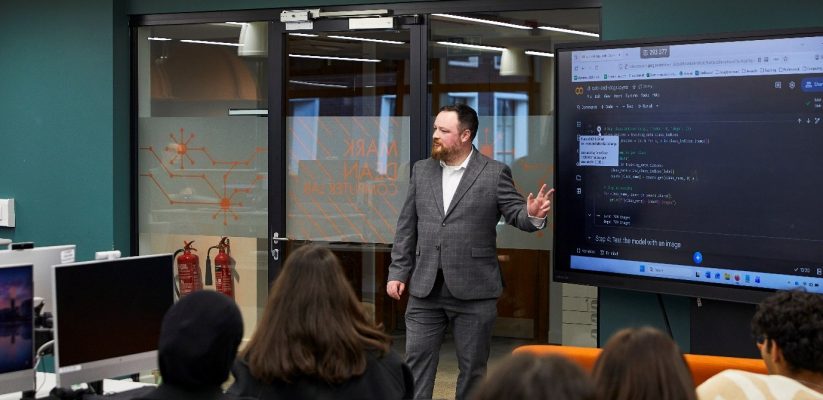
Artificial Intelligence is reshaping the way we live, work, and learn. Our new Artificial Intelligence BSc is being taught by academics who are actively shaping the field. We spoke to Dr Tom Oliver, Course Leader and Dr Sheema Noorain, Lecturer on the course, about their backgrounds, what excites them about AI, and why Westminster’s approach stands out.
Q: Could you tell us a bit about yourself and your area of expertise?
Tom: I’m a Lecturer at the University of Westminster and the Course Leader for our Artificial Intelligence BSc. With a PhD in mathematics, I’ve combined a strong research background with a passion for innovation in AI. Since first including AI in my research during the 2020 lockdowns, it has become central to my work. I’ve published several papers in machine learning and am constantly exploring new applications. I’m equally passionate about teaching and student collaboration, and I’m currently leading a staff-student project to create a cutting-edge LLM-based tool for mathematical notetaking, helping students engage with complex concepts in entirely new ways.
Sheema: I’m a Lecturer in Data Science and Analytics at the University of Westminster, where I focus on using data and AI to solve complex healthcare problems. I’m particularly interested in health informatics, predictive analytics, and the use of Generative AI to support better decision-making in healthcare, such as improving patient flow, predicting demand, and optimising resource allocation. I teach across undergraduate and postgraduate programmes, covering statistics, analytics, and operational research. My research background is rooted in mathematical modelling for healthcare, and I’m especially excited about how GenAI can make these complex analytical tools more accessible and actionable for professionals making critical decisions every day.
Q: What excites you most about artificial intelligence and its real-world applications?
Tom: What excites me most about artificial intelligence is that, at its heart, it’s a powerful problem-solving toolkit. AI gives us strategies to tackle challenges across virtually any domain, from analysing complex medical data to building tools that make creative work more effective. There’s a lot of hype and noise around AI, and some of it counter-productive, but for me the real excitement comes from using it to solve meaningful problems and explore new ways of thinking. At Westminster, students won’t just learn how to build AI systems, they’ll also learn how to use them effectively and thoughtfully.
Sheema: What excites me most is AI’s ability to transform decision-making across multiple sectors by bringing together information from many different sources. In healthcare, we have vast amounts of data, but turning it into clear, actionable insight is a real challenge. Generative AI opens new possibilities for interpreting complex information and delivering recommendations people can actually use. This potential extends far beyond healthcare – in finance, we can use AI to analyse market trends and risk patterns; in retail, it can help predict customer behaviour and optimize supply chains; in education, it can personalize learning experiences for different student needs.
This potential extends far beyond healthcare – in finance, we can use AI to analyse market trends and risk patterns; in retail, it can help predict customer behaviour and optimize supply chains; in education, it can personalize learning experiences for different student needs.
Q: In your view, what makes the Artificial Intelligence BSc at Westminster stand out from others?
Tom: Our BSc in Artificial Intelligence is designed with the future in mind. Students gain strong technical foundations across key machine learning paradigms, including advanced techniques like transformer architectures, while applied modules connect theory directly to real-world business challenges. We embrace innovative teaching methods, including the use of generative AI in assessments, and offer optional modules in areas such as robotics, data science, and computer game design. This gives students both academic depth and the flexibility to shape their own pathway in a rapidly evolving field.
Sheema: What really sets Westminster apart is our emphasis on practical, real-world application. Students do not just learn algorithms, they learn how to apply AI ethically and effectively to real problems across healthcare, finance, and business. By integrating generative AI and modern language technologies into the curriculum, we ensure students are working with the tools shaping today’s industries, while still building a strong understanding of the fundamentals.
Q: What inspired you to choose the University of Westminster?
Tom: I was inspired to choose the University of Westminster because of its strong commitment to social mobility, its clear focus on preparing students for successful careers, and its central London location, which offers unparalleled access to industry, culture, and innovation.
Sheema: Westminster’s commitment to accessible, practical education matched my belief that advanced analytics and AI should be available to everyone. The university’s diverse student community and focus on real-world applications created the perfect environment for developing teaching methods that make complex AI concepts understandable for people from all backgrounds. The opportunity to help develop new curriculum, particularly in areas like generative AI integration with traditional informatics, was also very appealing.
Q: What have been some highlights of your career so far?
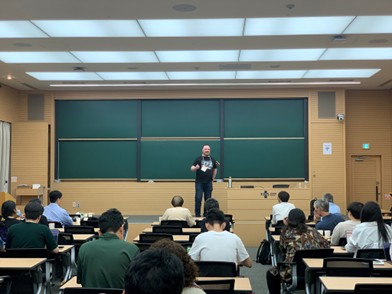
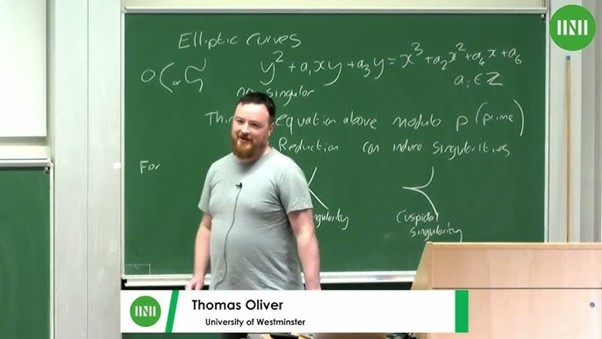
Tom: Some of the highlights of my career so far include having a scientific discovery featured in Quanta Magazine, presenting my work at conferences across the USA, Europe, Japan, and South Korea, and leading the development of the University of Westminster’s pioneering BSc in Artificial Intelligence. Each of these experiences has allowed me to combine research, teaching, and innovation in ways that continue to inspire my work today.
Sheema: Completing my PhD in 2024 on an integrated optimisation framework for healthcare services was a significant milestone. Developed in collaboration with an NHS trust, seeing my research translate into real-world healthcare improvements has been incredibly rewarding. I’m also proud of my publication demonstrating practical advances in healthcare informatics. Currently I am leading on the transformation of our Big Data Technologies MSc.
Q: What advice would you give to aspiring AI professionals?
Tom: Stay curious, think independently, and be prepared to work hard. AI is a powerful tool, but its true potential comes from combining technical skills with creativity and critical thinking. Those qualities will set you apart and allow you to make meaningful contributions in this fast-moving field. At Westminster, students will develop both skillsets.
Sheema: Focus on understanding both the technical skills and how to apply them to real problems. AI isn’t just about algorithms—it’s about solving actual challenges by smartly combining information with decision-making. Build strong quantitative skills but also learn to explain complex ideas clearly and work with people from different fields. Healthcare, finance, and public services all need AI professionals who can connect technical knowledge with practical understanding. Stay curious about new technologies like generative AI, especially how they can improve traditional optimization and informatics approaches. Most importantly, always think about the ethical implications and work to make AI accessible and helpful for diverse communities.
About Westminster
As one of the most diverse universities in the UK, we are a global university with London energy, with more than 19,000 students from 169 countries. To find out more about our Computer Science and Engineering courses, visit our website.

- Meet the Minds Behind our Artificial Intelligence BSc – Q&A with course team - December 17, 2025
- Clearing 2023 – How to choose your course - July 11, 2023