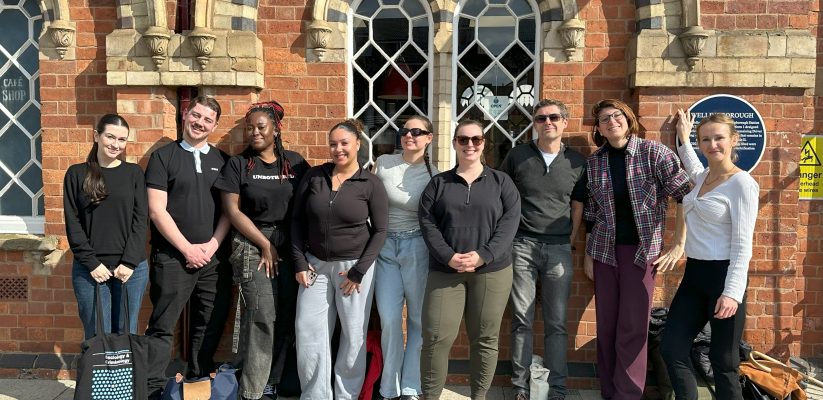
The Global Criminology MA Convict Criminology module at the University of Westminster offers an experience unlike any other. Last academic year, the module took place inside HMP Five Wells, a men’s prison in Wellingborough, where Westminster students studied alongside learners who are currently incarcerated.
Once a week for nine weeks, students travelled into the prison to attend classes co-taught by Dr. Sacha Darke and Dr. Andreas Aresti. Together, inside and outside students were introduced to the history and aims of convict criminology, with a particular focus on co-producing knowledge, expanding academic perspectives on prison life, and contributing meaningfully to debates around prison reform.
What we learned by studying together
For many Westminster students, this was their first time entering a prison. For others, it was their first experience of a UK prison. Similarly, the inside learners came from a range of educational backgrounds. Some were working towards undergraduate degrees, while others had studied at, or were considering, master’s level study.
Learning together helped break down common assumptions and barriers between those inside and outside the prison system. The diversity of experiences in the classroom created space for honest, nuanced discussions and challenged preconceived ideas about what prisons and people in prison are like.
Why lived experience matters in criminology
Across the weeks, discussions explored the realities of prison life, differences between prison experiences in the UK and internationally, and the challenges involved in changing prison policy and practice. Topics included stigma, barriers to accessing education in prison, the difficulties faced when leaving prison, and the importance of family support for those who are incarcerated.
Students also examined the origins of convict criminology, which emerged in the United States in the 1990s and was introduced to the UK in 2012 by Dr. Darke, Dr. Andreas Aresti and Dr. Rod Earle. Central to the movement is the idea that higher education should bring together academics with lived experience of prison and those without, allowing them to co-produce knowledge that is more accurate, inclusive and representative.
This approach highlights the importance of prisoner voices in shaping academic debates on prison policy. It offers insights that wider society, and even traditional prison research, often cannot access. At the same time, academics without prison experience contribute by synthesising perspectives and managing potential biases.
Looking closely at how prison policies work
One of the module’s key assessments was a co-produced group policy critique, focused on existing policies at HMP Five Wells. Groups examined topics such as rehabilitation strategies and the mixed regime that integrates sexual and non-sexual offenders. This work encouraged deeper exploration of how prison policies are designed, implemented, and where gaps or oversights often occur.
The module also took a strong international perspective. Guest speakers Dr. Francesca Esposito and Dr. Ramiro Gual shared insights into convict criminology in Italy and Argentina. Comparisons were also drawn between prison systems in Brazil, informed by Dr. Darke’s ethnographic work, and the UK, including Dr. Aresti’s lived experience. One of the long-term aims of convict criminology is for it to grow into a truly global academic movement.
Student reflections
“As a Brazilian, visiting a prison in another country and studying alongside individuals serving their sentences was fascinating. It allowed me to compare prison systems and identify similarities and differences in how prison is experienced.”
Renata Souza Almeida
“Being part of the Convict Criminology movement through my master’s degree allowed me to reflect on the importance of working with people in prison, rather than studying them. Seeing education used as a tool for change was deeply moving.”
Taylor Mainwood-Cox
Why this experience stayed with us
The Convict Criminology module offered a rare and powerful opportunity to learn about prisons from the inside out. By bringing together students from different backgrounds and lived experiences, the module demonstrated how co-produced knowledge can challenge dominant narratives, deepen understanding, and contribute to meaningful academic and social change.
As convict criminology continues to grow, the hope is that more students, both inside and outside prison, will take part in co-producing research, influencing policy, and reshaping how prisons are understood.
For those interested in learning more, keep an eye out for the forthcoming book Insider Prison Perspectives in Europe and the Americas: Convict Criminology at Westminster, co-produced by Westminster students, academics, and incarcerated learners, and due to be published by Routledge in 2026. The book will include one of the policy reports produced as part of this module.
Written by:
Lachlan Dorey
Based on reflections from:
Renata Souza Almeida, Victoria Lebrec and Taylor Mainwood-Cox
About Westminster
As one of the most diverse universities in the UK, we are a global university with London energy, with more than 19,000 students from 169 countries. To find out more about our Criminology and Sociology courses, visit our website.