The importance of undertaking an internship or work placement during the middle of your degree cannot be undermined. Not only does it add signifi cant weight to your CV, but it also provides a real
world context that the classroom alone cannot give. For me, securing an internship midway through my studies was transformative. It allowed me to step out of the theoretical bubble of lectures and assignments and truly envision what it feels to be working in professional setting. Experiencing
daily tasks of a workplace highlighted both my strengths and the areas I needed to improve.
Whether it’s an internship, a work placement, or even a short-term project, immersing yourself in a practical environment is the only real way of discovering how your skills translate in reality. It’s about navigating challenges, and realising that growth often comes from the unexpected moments outside of your comfort zone.
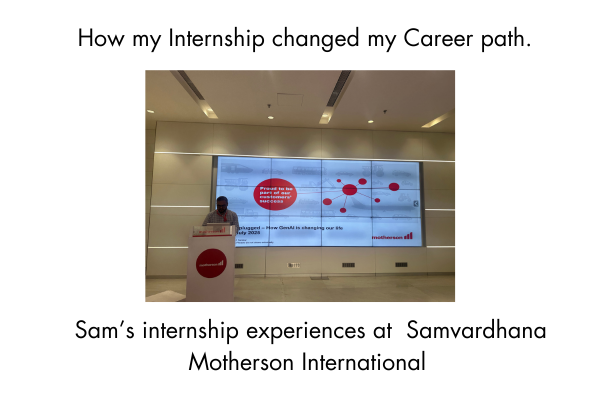
This summer, I had the prestigious opportunity to intern with Samvardhana Motherson International Ltd’s AI/ML team in New Delhi, India. My role was mainly centred around full-stack backend development, something I had long imagined myself doing. My first project involved working on a project to differentiate between complex engine architectures, an exciting challenge at first glance.

The role required skills like version control, debugging, and the ability to sit with code for hours, qualities I hadn’t fully developed. I came to understand that I lacked the strengths to be a full-time backend developer, not because I wasn’t interested, but because I didn’t feel my innovative and interactive skills were being used effectively. This was an important turning point, for the first time, I could see that my strengths didn’t align with the role that I had ben wanting to get into.

Things began to shift when I started contributing to projects that required not just coding, but also analysing requirements, making project estimations, and preparing presentations. I enjoyed mapping out processes on tools like Smartsheets and exploring how upcoming AI initiatives such as RAG and Agent AI could be positioned within the company. This blend of technical adaptability and commercial awareness opened my eyes to another side of the work that I found more engaging well aligned with my skillset.
The real breakthrough came when I was asked to help build a dashboard displaying key fi nancial metrics with supporting data. Here, I discovered how much I enjoyed modelling fi nancial information, identifying patterns, and creating outputs that could drive real business decisions. It was both challenging and enjoyable, and it made me realise that my future lies in this particular fi led, in the intersection of
finance, data, and technology. A space where I can use both my analytical skills and my innovative nature
to make an impact.


This particular shift in my career interests was something I could only discover by actually stepping into the workflow, experiencing the demands of projects first-hand, and working alongside industry professionals. It reinforced to me that internships and placements are far more than just a line on a CV,
they are opportunities to test yourself in real environments, uncover your strengths and weaknesses, and
define your vision for the future.

At the same time, securing these opportunities is not an easy task. In today’s competitive job market, tailoring your CV and cover letter to the role is simply not enough. Networking often plays a
major role. A referral can be the difference between your application being noticed or overlooked, especially when competing with a pool of strong candidates. Applying early certainly helps, but it is consistent networking, both within your university and beyond that truly increases your chances.
Looking at networking from a wider lens is key. Attending industry events, career fairs, and professional meetups outside the university environment exposes you to people working in the fields you aspire to enter. These conversations not only build connections but also provide insights into the realities of different roles, helping you align your career path with your skills and interests. For me, this journey has made it clear that internships aren’t just about ticking boxes, they are about transformation, discovery, and positioning yourself for where you can make the greatest impact.
At last, I believe this is the best way to truly find your niche is through testing yourself in real environments and reflecting on what excites you most. Before stepping fully into the job market and pursuing full-time roles, internships and placements offer a powerful way to understand your strengths, recognise where you can add value, and start shaping your career path with intention.
***
Big thanks to Samaksh, one of our BSc Computer Science students, for this insightful blog!
About Samaksh: “I am Samaksh Chhibber. A final year undergraduate student at the University of Westminster studying Computer science. My passion is innovation and hence my aim is to create technologies that can pave the way for future. I am keen on pursuing entrepreneurship. I take keen interest in studying astronomy in my free time. A fun fact about me is that I wrote a book at 17, combining my interest of astronomy with philosophy.“
Remember: if you need careers support, your Careers Team is only an email / a message away!
E: careers@westminster.ac.uk| Website | Facebook | Twitter | Instagram |Careers Blog

- Thinking about a placement year but not quite sure if it’s right for you? - 26 March 2026
- Applying for the Undergraduate of the Year Award: Munawar Nuur - 24 March 2026
- Are you trying to find a part-time job? - 12 March 2026