At Westminster, we provide students with the opportunity to combine creativity with technical expertise, either through their course or independent projects, preparing them for careers in the digital technology and immersive media industries. Students gain hands-on experience with web and 3D technologies, interactive media, and industry-standard tools, developing the programming, design, and professional skills needed to create innovative digital experiences.
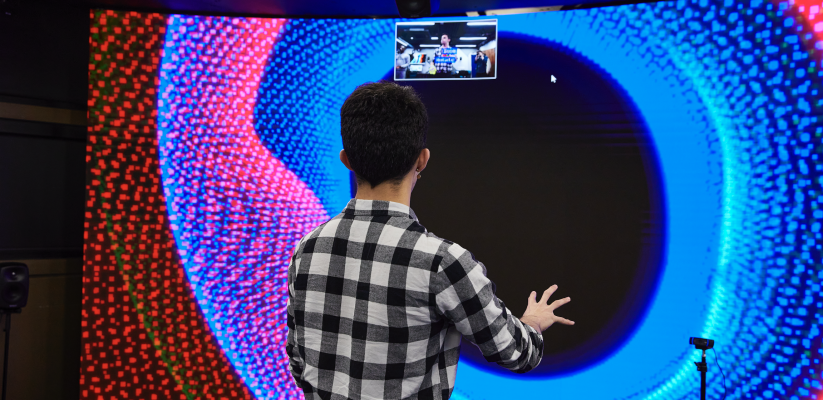
Our Immersive Development Lab, is a state-of-the-art facility featuring motion capture, VR/AR, spatial audio, and virtual production technology. The Lab gives students the space, equipment, and support to experiment, develop ambitious projects, and collaborate on research or industry briefs.
In this Q&A, we speak with Jeff Ferguson, Senior Lecturer and Director of the Lab, about the Lab, and how students are prepared to navigate the ever-changing world of creative technology.
Can you tell us a bit about yourself and your area of expertise?
I am currently a Senior Lecturer at the University of Westminster and Director of the Immersive Development Lab at the university.
After studying Illustration and working in traditional drawn animation, I retrained in computing and began my career in the early multimedia industry. This led me into the rapidly growing games sector, where I spent 10 years working on AAA console and PC titles, specialising in 3D character design, animation and motion capture.
Seeking new challenges, I moved into interactive software, developing bespoke installations using motion capture, haptics and VR for games companies, research institutions, universities and brand-led public events. Throughout my career, I’ve focused on combining the right mix of software and hardware to deliver stable, cost-effective and creatively ambitious solutions.
While teaching motion capture part-time at Westminster, I completed a master’s in computational arts to expand my practice. I later joined the University full-time, where I now design and teach modules exploring the intersection of the creative industries and computing, with a focus on interactive coding.
Can you tell us about the Immersive Development Lab and its mission?
The Lab brings together a wide range of professional-grade systems, fully supported and designed to work seamlessly together for maximum creative potential. Developed over the past two years in collaboration with industry professionals, the space was conceived as a flexible, future-facing environment, combining a high concentration of permanently installed equipment with full-time technical support for drop-in use.
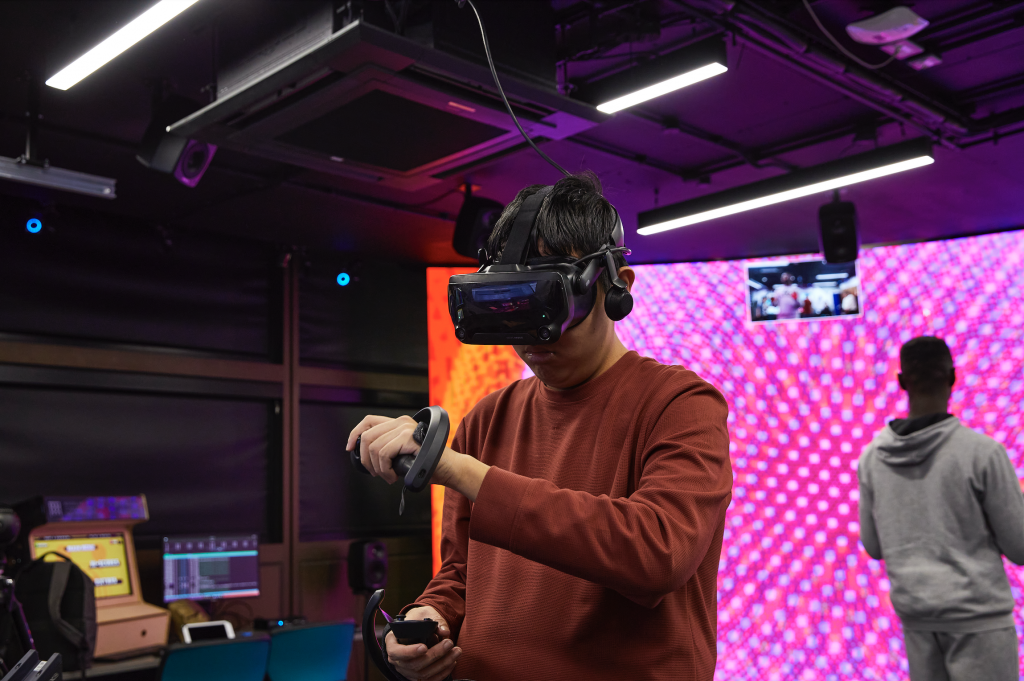
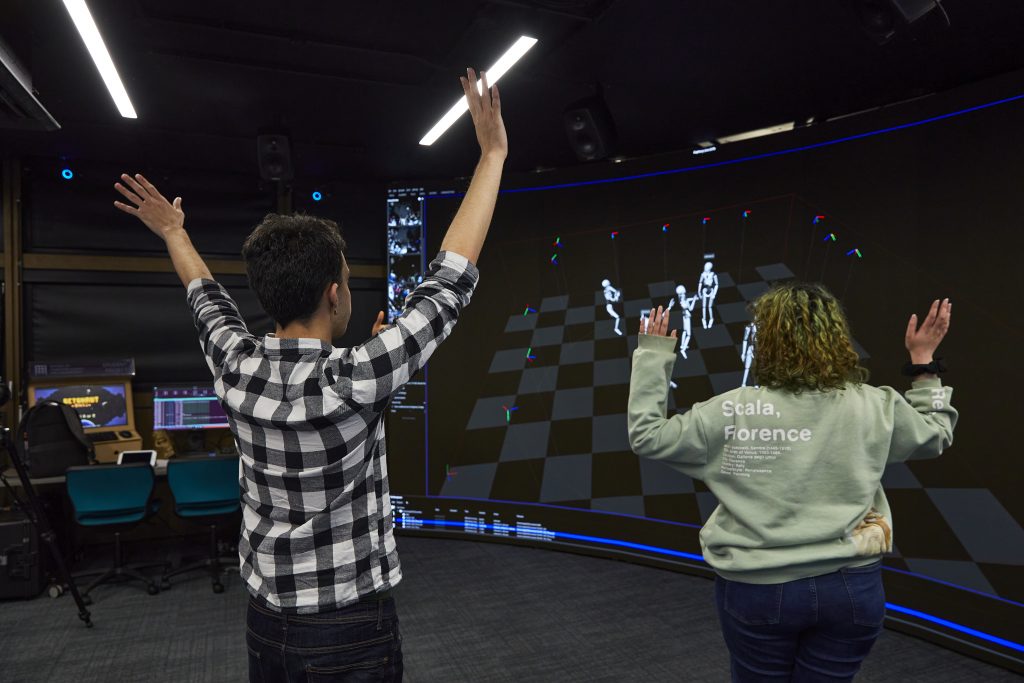
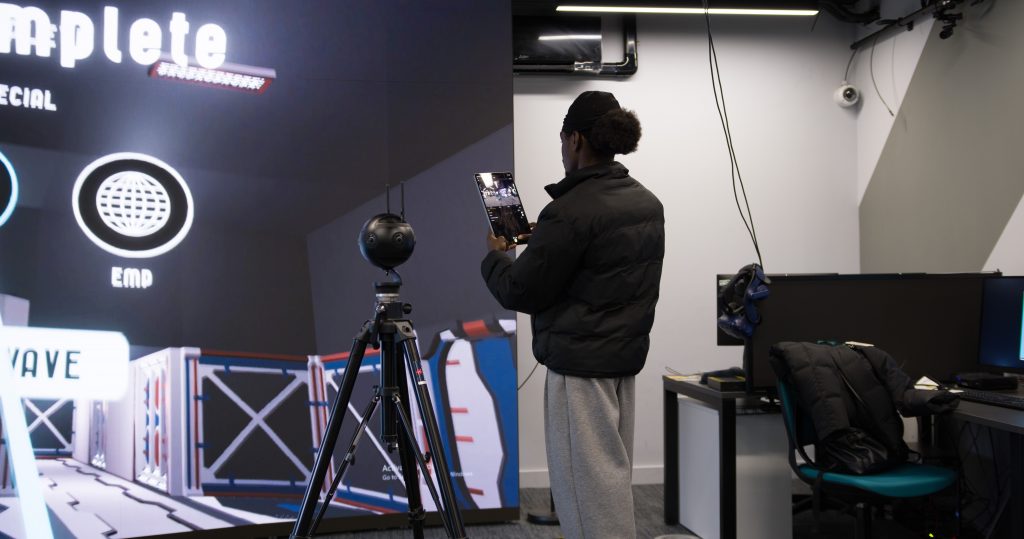
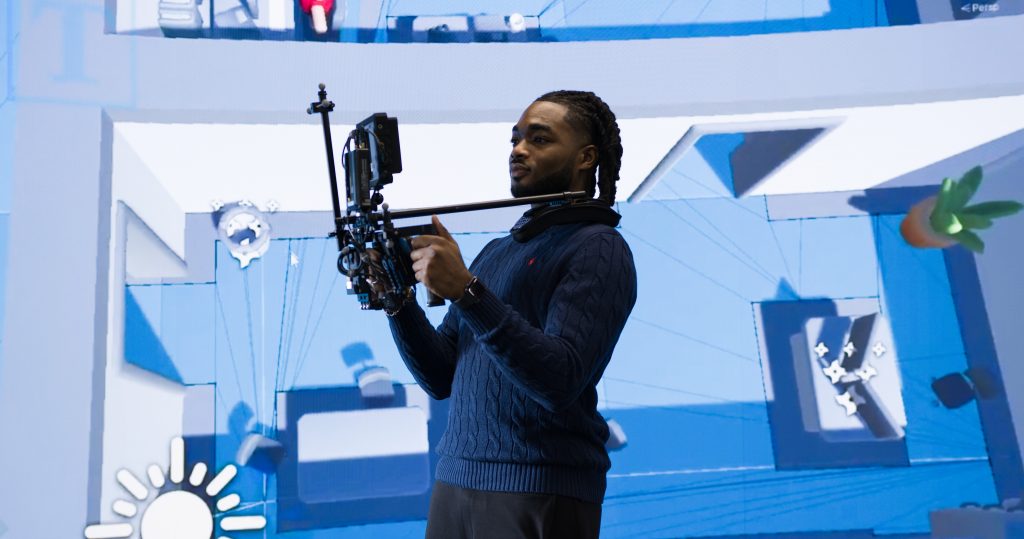
Some of the facilities featured in the lab include both marker-based and markerless motion capture systems, 360° cameras, a large LED wall for immersive applications and virtual production, multi-user tracked VR headsets, portable VR systems, a virtual camera setup, and a 360° spatial audio system.
Students can book dedicated time in the Lab and on specific equipment. We also design and share tailored workflows, ensuring students are fully supported in integrating hardware and software effectively, empowering them to translate ambitious ideas into innovative creative outcomes.
How does the lab connect to Westminster’s courses?
Several core and optional modules make direct use of the Lab, giving students hands-on access to professional systems while developing the technical and creative skills to use them confidently. Beyond teaching, the Lab also supports research, independent projects and industry collaboration.
It functions as a live demonstration environment for ambitious student work — from large-scale immersive installations driven by gesture input to virtual production projects using game engines and live-streamed motion capture. Within the same space, students can access a dedicated motion capture studio for recording and real-time input, as well as an immersive sound studio for standalone spatial audio projects or audio integration within VR, games and interactive experiences.
Importantly, while the Lab provides access to specialist, high-end equipment, the broader aim is to equip students with adaptable skills enabling them to create software-driven or consumer-hardware-based solutions that are scalable, accessible and cost-effective beyond the university environment.
What excites you most about leading and teaching in the lab?
This is the culmination of a personal journey to combine the technical with the artistic. I’m excited by the incredible range of possibilities and connections that exist between many areas today. Coding, digital art, web platform technology, embedded systems, computer vision, tokenisation, digital primitives and generative AI.
There is a wealth of open-source material, platforms and content that can be used and repurposed into new and astonishing forms, and the people who master this alchemy are the success stories of tomorrow. The vital area is where innovative technology meets creativity, with only one recent example being Gaussian-Splat environments being used to generate infinite online worlds to interact with.
How does the lab prepare students for industry or further research?
The course and Lab provide multiple pathways for students to engage with real-world challenges and industry-standard practices. Many final-year projects are developed in partnership with companies, allowing students to tackle authentic tasks and gain practical experience. Beyond this, students participate in students as co-creators projects with defined budgets, developing extracurricular initiatives such as our recent digital twin of the University and interactive driving simulators. Modules are designed to present real-world challenges, often with input and mentorship from industry professionals.
The Lab also supports a growing cohort of Master’s and PhD students undertaking innovative research. This creates unique opportunities for undergraduates to engage in knowledge exchange, collaborate on cutting-edge projects, and gain exposure to advanced methodologies and research practices — helping them build skills that are directly applicable to both professional and academic pathways.
What would your advice be to aspiring professionals who would like to pursue a career within creative computing industries?
Be rigorous in your approach. Be open minded in your investigations. Invite solutions that are both technical and creative to be unique in this world. Also – know when to go low-tech!
About Westminster
As one of the most diverse universities in the UK, we are a global university with London energy, with more than 19,000 students from 169 countries. To find out more about our courses, visit the University of Westminster website.
Credit for images:
using software by “Alan from Fun with Computer Vision”
https://www.funwithcomputervision.com/
