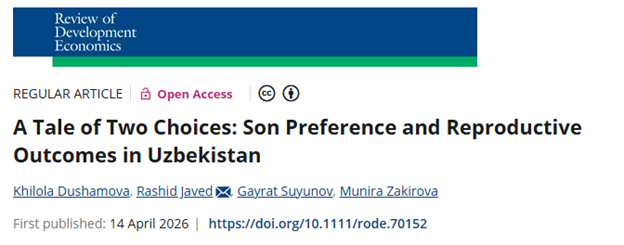
A recent study by Khilola Dushamova (Westminster International University in Tashkent), Rashid Javed (Northumbria University), Gayrat Suyunov (Westminster International University in Tashkent) and Munira Zakirova (Westminster International University in Tashkent) examines the prevalence of son preference and its impact on reproductive behaviour among Uzbek families, using a 2021/22 sample from the Uzbekistan Multiple Indicator Cluster Survey (MICS). The paper, A Tale of Two Choices: Son Preference and Reproductive Outcomes in Uzbekistan, is now available in the Review of Development Economics as an open-access article.
Dushamova, K., R.Javed, G.Suyunov, and M.Zakirova. 2026. “A Tale of Two Choices: Son Preference and Reproductive Outcomes in Uzbekistan.” Review of Development Economics, 1–16. https://doi.org/10.1111/rode.70152.
Do parents in Central Asia have a preference for boys? Historically, Central Asian countries tend to view sons as symbols of family continuity – responsible for carrying on the family name, inheriting property, and caring for ageing parents. A daughter is like a crop that parents put effort into but can never reap the benefits of their harvest. For centuries, a girl represented a guest who eventually leaves her parental home to join her husband’s family.
In Central Asia, Uzbekistan has the highest sex ratio at birth -108 boys per 100 girls, a persistent record for over four decades. Although recent legal reforms have promoted gender equality, deeply rooted customs continue to influence family dynamics. Even today, son preference is reflected in Uzbek couples’ reproductive outcomes.
Son preference manifests in different forms. One such behaviour is gender-specific birth-stopping, whereby couples are significantly more likely to cease childbearing once a son is born. According to the findings, Uzbek women are up to 36% less likely to have a subsequent birth if they have at least one son at a given birth order. Interestingly, the sex of the firstborn child, whether it is male or female, does not affect a couple’s decisions about having another child. More than 80% of women have a second birth irrespective of the sex of the firstborn child. However, after having two children, the decision to have a third child or more is driven by the gender of the first two. Having all girls significantly increases the likelihood of continued childbearing compared to a mixed-sex composition or all-boys families.
These patterns result in a higher proportion of women with at least one son at higher birth orders. For instance, in the first birth order, 49% of women have a son as a first or only child, while 51% have a daughter, closely reflecting the biological gender proportion. In contrast, in a family with four children, 90% of women have at least one son. It shows that couples opt for larger families in expectation of having a son.
Son preference is also reflected in birth spacing behaviour: families with no sons tend to have shorter subsequent birth intervals, i.e., shorter time between two consecutive live births. Short birth intervals, defined as a pregnancy occurring within 15 to 18 months of a previous childbirth, pose increased risks for maternal health and the child’s well-being. Yet, women without sons still opt for risky birth intervals: 47% of women without a son experience a short birth interval. Whereas the birth of a son can delay subsequent births by 14% to 23%. Couples with at least one son take quality time before deciding to have another child, unlike their no-son counterparts. To delay subsequent births or stop childbearing, families opted for the use of contraception. Women having at least one son are up to 8.9% more likely to use contraceptives. By the age of 45, the reproductive window is largely closed.
Overall, A Tale of Two Choices: Son Preference and Reproductive Outcomes in Uzbekistan shows that son preference exists and strongly influences fertility intentions and behaviours among Uzbek families. The reasons for the persistence of such a preference are yet to be investigated, but Uzbek customs still hold that a son is preferred over a daughter.
Authors
Khilola Dushamova WIUT Business School, Westminster International University in Tashkent, Uzbekistan Email: k.dushamova@wiut.uz
Dr. Rashid Javed Newcastle Business School, Northumbria University, UK Email: rachidjaved@gmail.com. Twitter@ rachidjaved
Gayrat Suyunov WIUT Business School, Westminster International University in Tashkent, Uzbekistan Email: gsuyunov2@wiut.uz
Munira Zakirova WIUT Business School, Westminster International University in Tashkent, Uzbekistan Email: m.zakirova@wiut.uz