Low Traffic Neighbourhoods in London Research Study
Low Traffic Neighbourhoods in London Research Study: a mixed-methods study of benefits, harms and experiences (January 2022-Sept 2025)
What is a Low Traffic Neighbourhood?
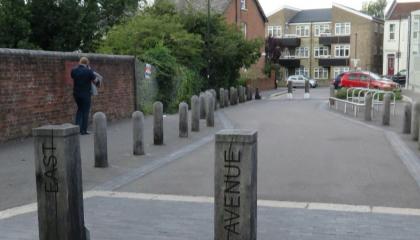
Low Traffic Neighbourhoods (LTNs) are transport interventions that restrict through motor traffic in a set of residential streets. Their aim is to make walking, wheeling, and cycling (active travel) safer and more comfortable within the area covered (as there are fewer cars passing through), and make driving through the area less convenient, both of which, it is hoped, will encourage people to walk, wheel, or cycle instead. LTNs commonly use “modal filters” to prevent motorised through-traffic whilst retaining access for people walking and cycling. Modal filters can be street furniture such as planters or bollards, or camera enforced closures.
By the end of 2020, 4% of Londoners (300,000 people) lived in areas covered by 72 LTNs introduced between March to September 2020 as part of the Covid-19 response. While some have been removed, most were retained and more are planned to be implemented across London.
A modal filter in North-East London
LTNs have been controversial. Before we started our study, there was some promising evidence of benefits, including increased active travel, a reduction in road traffic injuries and street crime, and decreased car ownership and use (all of which are important policy goals in London). There were also concerns about adverse impacts, for instance for residents on scheme boundary roads if motor traffic increases there, or on those disabled people who need to use cars and whose journeys may take longer. These debates continued with Transport for All’s Pave the Way report finding that disabled people interviewed perceived both positive and negative impacts from LTN interventions. Our project contributed to building solid evidence about impacts associated with LTNs, studying benefits, harms, and experiences of these changes.
Aim of the study
The aim of the study was to examine the potential benefits and harms of new LTN schemes, understand the experiences of those living in or near LTNs, and consider how policymakers can navigate controversy. Questions we answered included:
Do new LTNs lead to greater levels of, and more diverse, walking and cycling, compared to areas without them
What are the health benefits from these schemes (e.g. reduced road injury risk)?
Do these schemes cause harms, including congestion on boundary roads or longer journeys for those disabled people who are reliant on cars?
How do local people experience and respond to LTNs?
How can policymakers navigate controversy surrounding these schemes, and make them more inclusive?
What we did in this study?
Our study focused on 5 new LTNs implemented in London between 2021 and 2023, plus an equal number of matched control areas (which are areas with very similar characteristics, but which are not getting an LTN). This study collected and analysed different types of information. This included:
Quantitative (numerical) follow-up data in LTNs and control areas for three years. This covered numbers of pedestrians, cyclists, and motor vehicles; age and gender diversity among people walking, wheeling, and cycling; congestion on boundary roads; and local car journey times.
Modelling of the health and health economic impacts of LTNs, via the pathways of physical activity, injuries, and air pollution.
Conducting interviews about experiences of LTNs with local residents, including disabled people, and with policymakers. We interviewed residents and policymakers twice to explore how experiences changed as LTNs ‘bed in’.
Why was this research needed?
We needed to know if goals such as increasing walking, wheeling, and cycling and reducing road injury risk were being achieved. We needed to understand the daily experiences of people living within or near the low traffic neighbourhoods and how it impacts them and their journeys, both positively and negatively. This includes understanding how inclusive schemes are by exploring the experiences of residents with diverse travel needs and barriers, including disabled people. By speaking to policymakers involved in the LTNs, we also gained insights into the implementation process and how they navigated any controversies. This research provides policymakers with robust and timely evidence that can inform the future of transport interventions and ensure that they are inclusive.
Here is a regularly updated list with all the academic articles published to date from this study (eleven, as of September 2026). There are still several under peer review. Once the remaining articles are accepted for publication, we will share a final video update.
Publications from the study
Peer-reviewed academic journal articles and book chapters
Khreis, H., Williams, M., Lad, C., Fevyer, D., Laverty, A.A., Jinks, D., Furlong, J., Woodcock, J., Edwards, P., and Goodman, A. (2026), The modelled impact of low traffic neighbourhoods (LTNs) on air pollution: findings from 5 schemes in London,
Environmental Research, Volume 306, Part 1, – https://www.sciencedirect.com/science/article/pii/S0013935126014246
Larrington-Spencer, H., Verlinghieri, E., Aldred, R., Lawlor, E. & Fevyer, D., (2026) “Everyday Discourses of Climate Delay in Opposition to Low Traffic Neighbourhoods”, Active Travel Studies 6(1). https://activetravelstudies.org/article/id/1811/
Verlinghieri, E., Thomas, A., Aldred, R. and Larrington-Spencer, H. 2026. Contested streets as social infrastructures. In: Latham, A. and Layton, J. Social Infrastructure: Studying The Facilities that Sustain Community, Social Networks, and Trust in Neighbourhoods and Cities.
Verlinghieri, E., Aldred, R., Larrington-Spencer, H., Goodman, A., Lawlor, E., Navarro, L., Khreis, H., Laverty, A. 2026. Street space reallocation under austerity: the case of Low Traffic Neighbourhoods in the UK. Transport Policy (179), 104013. https://doi.org/10.1016/j.tranpol.2026.104013
Furlong, J., Fevyer, D., Armstrong, B., Edwards, P., Aldred, R. and Goodman, A., 2025. Low Traffic Neighbourhoods in London reduce road traffic injuries: a controlled before-and-after analysis (2012–2024). Injury Prevention. https://doi.org/10.1136/ip-2024-045571
Furlong, J., Fevyer, D., Casement, B., Aldred, R., Laverty, A., Armstrong, B., Edwards, P. and Goodman, A., 2025. Removing through-traffic on minor roads reduces road danger at junctions with surrounding Major roads. Findings, August. https://doi.org/10.32866/001c.143455
Verlinghieri, E., Larrington-Spencer, H., Furlong, J., Aldred, R., Goodman, A. 2025. Can mixed-methods help us better understand congestion on Low Traffic Neighbourhood boundary roads? Journal of Transport Geography 128, 104360, https://doi.org/10.1016/j.jtrangeo.2025.104360
Verlinghieri, E., Larrington-Spencer, H., Pathania, A., Goodman, A., Furlong, J., & Aldred, R. 2025. Walking and wheeling in Low Traffic Neighbourhoods: A mixed methods study of mobility aid users’ interactions with changing public spaces. Cities & Health, 1–20. https://doi.org/10.1080/23748834.2025.2571279
Larrington-Spencer, H., Verlinghieri, E., Lawlor, E., and Aldred, R. 2024. Troubling go-alongs through the lens of care. Qualitative Research 25(3). https://doi.org/10.1177/14687941241277747
Other articles
Furlong, J., Larrington-Spencer, H., and Verlinghieri, E. 2023. What does the evidence on Low Traffic Neighbourhoods really show? Public Sector Focus, July-August 2023.
Dr Ersilia Verlinghieri, University of Westminster (Joint Lead)
Dr Anna Goodman, London School of Hygiene & Tropical Medicine (Joint Lead)
Professor Rachel Aldred, University of Westminster (Co-Investigator)
Patrice Ajai-Ajagbe, University of Westminster (Project Manager)
Quantitative Research and Health Impact Analysis
Dr Jamie Furlong, University of Westminster
Asa Thomas, University of Westminster
Dr Anthony Laverty, Imperial College London
Professor James Woodcock, University of Cambridge
Dr Haneen Khreis, University of Cambridge
Professor Philip Edwards, London School of Hygiene & Tropical Medicine
Professor Benedict Armstrong, London School of Hygiene & Tropical Medicine
Qualitative Research
Dr Harrie Larrington-Spencer, University of Westminster
Dr Emma Lawlor, University of Westminster
Luz Navarro, University of Westminster
Caroline Stickland, Transport for All
Emma Vogelmann, Transport for All
Alisha Pathania, Transport for All
Funder
The study was led by the University of Westminster. The study was funded by a grant from the National Institute for Health and Social Care Public Health Research Programme (NIHR135020).
University of Westminster
309 Regent Street, London W1B 2UW
General enquiries: +44 (0)20 7911 5000
Course enquiries: +44 (0)20 7915 5511
The University of Westminster is a charity and a company limited by guarantee. Registration number: 977818 England