Kerbside Greening: The opportunities in our streets
Louise Rondel and Dulce Pedroso
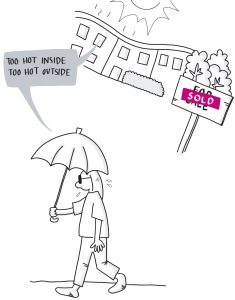
The UK’s climate is changing dramatically and the effects are being lived on our streets. From hotter summers and unshaded streets that are hard to walk, wheel or cycle along to growing flood risk and damage to homes and businesses, we are increasingly experiencing the climate emergency in the everyday spaces in which we live.
These experiences are not felt in the same way by everybody (every body). In the UK, vulnerability to the different effects of the changing climate is patterned by intersecting social dynamics: people from the global majority, people from lower socio-economic groups, disabled people, children and older people are both most impacted by and least able to ‘weather’ climate change. Variably, these are groups who disproportionately experience the worst of the Urban Heat Island effects (where city spaces are prone to hotter temperatures because of their hard and densely-built surfaces which absorb heat and slow cooling amongst other factors); have lower access to green and blue spaces; live in places with fewer trees (so less shading and other cooling mechanisms); live in areas with higher risk of flood; and experience higher levels of air pollution than more affluent communities with a higher proportion of white, non-disabled and young adults.
Faced with the changed and changing climate, adaptations need to be made to governance, policies and the built environment both to reduce our contributions to carbon emissions and to prepare for the worst of the impacts, whilst supporting the most affected populations.
Dr Ersilia Verlinghieri, Dr Louise Rondel and Dulce Pedroso from the Active Travel Academy have been working with the climate action organisation Possible and the London Borough of Newham on a project which explores the possibilities for greening the kerbside in East London.
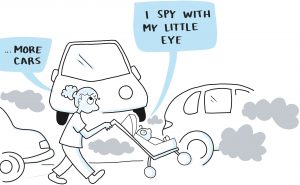
The project has focused on two streets in the borough of Newham in East London. These were selected as sites for the research and the possible implementation of greening initiatives because they have been identified as priority locations on Possible’s Street Trees Data Explorer. They are places which experience a high Urban Heat Island effect and a high level of air pollution and have a low level of tree canopy cover.
In these two sites, we carried out workshops with local residents focusing on their experiences of life in their neighbourhood, living with trees and other greenery (the joys but also the difficulties as trees can add to the obstacles on the footway or their roots can pull up the asphalt), navigating heatwaves, concerns about heat and flood risk, and moving through the streets. Through a series of ‘utopic imaginings’, we also explored the workshop participants’ hopes for the future of their area. Nothing unrealistic nor unrealisable, rather quite ordinary, elements which by-and-large exist in other parts of the city: more greenery, more wildlife, more spaces for play and socialising, less rubbish and pollution, more places to rest on the street, more accessible places for walking, wheeling and cycling.
Alongside the workshops, we have been conducting interviews with people who are working in the arena of urban greening. We have spoken to council officers and councillors from the London Boroughs of Hackney, Camden and Lambeth who have introduced greening into the carriageway as well as to representatives from The Woodland Trust and Street Trees for Living to learn from their experiences of carrying out this work, their successes, the challenges they have encountered and how these have been overcome. Throughout, we have been told about the overlapping of active travel measures and the implementation of greenery, the importance of strong policies and political support for kerbside greening as well as the importance of community voices.
Working with Possible, we have explored interlinked opportunities offered by the greening of streets:
- planting in the carriageway to implement essential greening whilst maintaining the accessibility of the footway and reclaiming space usually used for motorised vehicle parking;
- engaging people in conversations about climate change and the adaptations that need to be made to cities whilst also empowering them to get involved in shaping where they live.
- In turn, spotlighting citizens’ hopes for the future of their streets for local authorities and politicians and, through this, feeding back into decision-making.
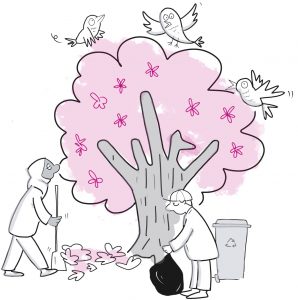
During the workshops, we made steps into these opportunities as we began to co-create visions of what participants want for the streets where they live; to make connections between community members and share concerns and knowledges; and to think about possible political mobilisations and future actions. What has emerged from the conversations with workshop attendees and interviewees working in the sphere is a series of points of departure for greening our neighbourhoods, not only showing that green and liveable streets are important to residents but also how communities can come together to mobilise for change.
The full report from the project is available here.
The workshops were live illustrated by Dulce Pedroso.
Images: Dulce Pedroso